RLRL
Repeated Low-Level Red Light Therapy
A non-invasive, drop-free myopia control treatment now backed by five-year real-world data across nearly 3,000 children, showing strong and sustained results.
A non-invasive, drop-free myopia control treatment now backed by five-year real-world data across nearly 3,000 children, showing strong and sustained results.
Repeated low-level red light therapy involves a child looking into a desktop device for a brief session, typically around three minutes, twice a day, viewing a low-level red light at a specific wavelength. It's non-invasive, involves no lens wear and no eye drops, a genuinely different treatment mechanism to our other four options.
RLRL has moved decisively beyond its early emerging status. A landmark multicentre randomised controlled trial first established its effectiveness, and more recently a large five-year real-world study has confirmed strong, sustained results with a well-documented safety profile.
The 2026 study, published in Advances in Ophthalmology Practice and Research, is one of the largest real-world RLRL datasets to date.
Followed across seven provinces, one of the largest real-world RLRL cohorts published to date.
Effective axial length control was maintained across the full five years of follow-up, not just an initial period.
The large real-world cohort found no serious safety concerns associated with RLRL use.
Around three minutes, twice a day, a small daily commitment for a meaningful treatment effect.
Children with higher adherence to the twice-daily schedule achieved meaningfully better axial length control.
RLRL's evidence base has grown from early trial data into one of the largest real-world myopia control datasets available.
Your child looks into the device for around three minutes, twice a day, viewing a low-level red light.
The five-year study found effective control, annual growth under 0.1mm, in 53.8% to 62.3% of children each year, sustained across the full follow-up period.
Control rates were strongest in older children, aged 13 to 17, and closely tracked how consistently families followed the twice-daily schedule.
53.8% to 62.3% effective axial length control across each year of a five-year study.
No serious safety concerns identified across nearly 3,000 children in real-world use.
A genuinely different, needle-free, lens-free treatment mechanism.
Around three minutes, twice a day, a small addition to a daily routine.
Sustained control confirmed across all five years of the largest published dataset.
Sits alongside OrthoK, contact lenses, glasses and atropine in our treatment program.
We offer RLRL as one of our five evidence-based treatment options, with hands-on setup and ongoing monitoring for every family.
We confirm RLRL is a good fit and establish a baseline axial length measurement.
We demonstrate correct technique and session timing before your child begins sessions at home.
We review at regular intervals, tracking axial length and refraction to confirm treatment is working.
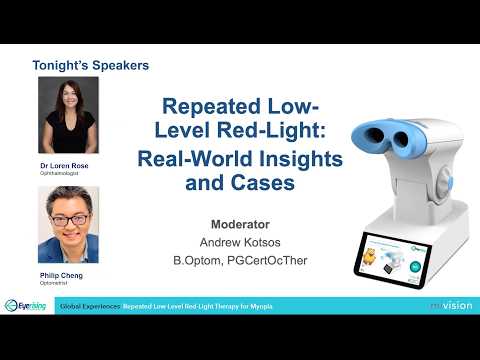
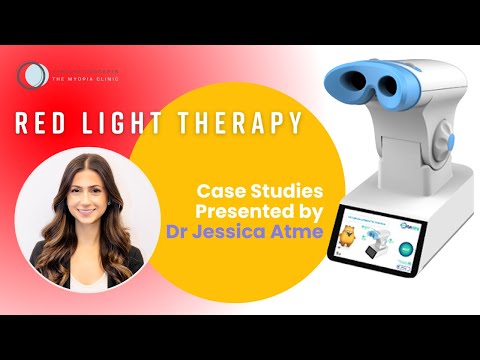
Dr Philip Cheng has presented webinars on repeated low-level red light therapy, covering the evidence, safety data and how we use it in clinic. Watch both below.
Book a comprehensive myopia assessment and we'll talk through RLRL and how it compares with our other treatment options for your child specifically.
Individual results vary. RLRL device use should always follow the correct twice-daily session protocol under our clinic's guidance. This page is general information, not medical advice, please speak with one of our optometrists about whether RLRL is suitable for your child.