Myopia, or short-sightedness, is the most common refractive error we see — and the one we focus on most closely, because in children it's an eye health condition as much as a vision one.
Myopia means the eye is slightly too long relative to its focusing power. It's one of four common refractive errors, alongside hyperopia, astigmatism and presbyopia, where the eye simply doesn't bend light the way it needs to for a sharp image.
With myopia specifically, distance vision blurs while close-up vision usually stays clear, at least early on. It's an extremely common condition, affecting a large and growing share of children and adults, and it's the refractive error we spend the most time on, because how it's managed in childhood has consequences that last a lifetime.
Clear vision depends on light from what you're looking at converging to a single, precise point exactly on the retina, the light-sensitive layer at the back of the eye. In a myopic eye, the eyeball is a little too long for its focusing power, so that point falls in front of the retina instead of on it.
By the time the light actually reaches the retina, it has already crossed over and started spreading out again, landing as a blurred circle rather than a sharp point. The further away an object is, the more pronounced this effect becomes, which is exactly why distance vision blurs first and closer objects tend to stay clearer for longer.
This is purely a focusing problem, not a sign that anything is diseased or damaged. But in children, an eye that keeps growing more elongated year on year is doing more than just needing a stronger prescription, which is why we watch axial length and progression closely, not just the number on the prescription.
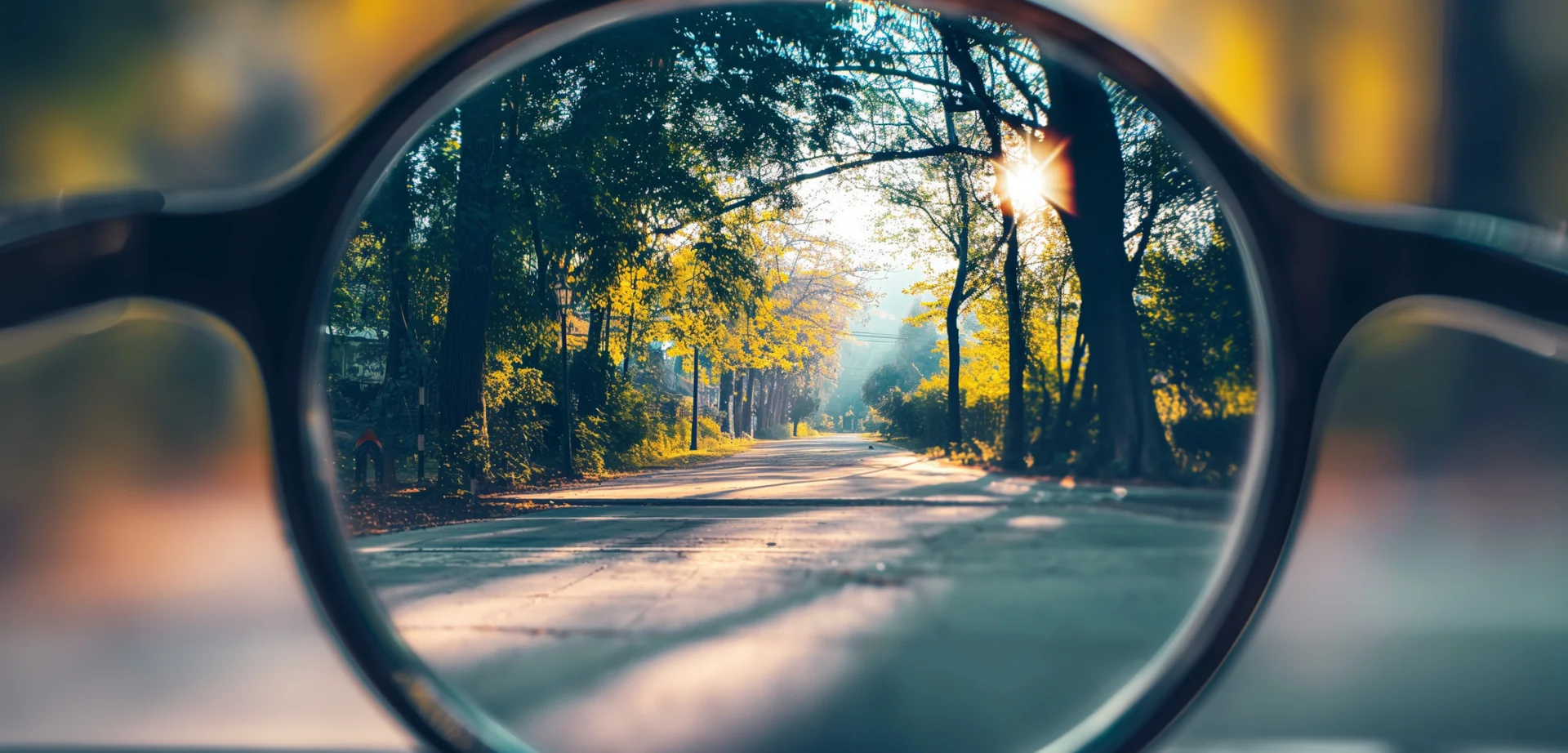
Myopia often develops gradually, especially in children, so the signs can be easy to miss at first.
Difficulty reading road signs, the whiteboard, or the TV clearly from across the room, while reading up close often still feels fine.
Narrowing the eyes to see distant objects more sharply is a common, often unconscious, sign of uncorrected myopia.
Children in particular will sit closer to the TV or hold books and devices nearer their face to bring things into focus.
Straining to focus on distant objects over the course of a day can bring on tired eyes or headaches, especially after school or screen time.
Most adults with myopia are stable and just need the right correction. Children are different: their eyes are still growing, so myopia frequently keeps progressing year after year, adding to the eye's final length and to lifetime eye health risk with every extra dioptre. This is why catching and monitoring myopia early matters so much.
Progression isn't strictly a childhood story either. There's a common perception that myopia stops progressing around age 18, once school finishes and eye growth is assumed to be done. We now believe that's no longer true for a meaningful number of people: emerging research shows progression can continue well into the mid-to-late twenties. In practice, this means myopia management isn't only for kids: children, teenagers and young adults can all benefit if their myopia is still advancing, and it's worth having progression checked rather than assumed finished based on age alone.
Correcting myopia simply means refocusing light back onto the retina. We offer three ways to do this, and the right one depends on your age, lifestyle, and prescription.
The simplest and most flexible option. A correctly prescribed lens bends light so it converges precisely on the retina instead of in front of it, restoring sharp distance vision instantly whenever they're worn. See our eyewear collection.
Sitting directly on the eye, contact lenses correct myopia the same way glasses do but without a frame in your field of view, which suits sport, active lifestyles, and personal preference. Explore our contact lens options.
Specially designed rigid lenses worn overnight gently reshape the front surface of the eye while you sleep, so you see clearly all day with nothing to wear. Find out more about OrthoK at Eyecare Concepts.
Glasses, contact lenses and standard OrthoK all correct blur, but on their own they don't slow down a progressing myopic eye. For anyone whose myopia is still increasing year on year, whether a young child, a teenager, or a young adult, that's where myopia management comes in: specific lens designs and treatments chosen not just to make vision clear now, but to slow how much the eye keeps elongating over time.
This is where we place our strongest clinical focus at Eyecare Concepts, using purpose-built myopia control contact lenses and glasses, specialised OrthoK, and atropine eye drops, guided by axial length monitoring rather than the prescription number alone. Our Myopia Control page covers the evidence and the treatments in full detail.
This page is an overview. For a deeper look at any part of the myopia picture, start here.
A deeper dive into causes, risk factors, axial length and how myopia is diagnosed and monitored.
Read more →The evidence-based treatments we use to slow myopia progression in children, teenagers and progressing young adults, and why it matters.
Read more →Why a longer, more myopic eye carries higher lifetime risk of conditions like retinal detachment, myopic maculopathy and glaucoma.
Read more →See how myopia compares with hyperopia, astigmatism and presbyopia, and how each affects vision differently.
Read more →Whether it's your first pair of glasses or you're exploring myopia control for your child, a comprehensive eye test is the place to start. We'll measure your prescription, assess your eye health, and talk through the correction and management options that suit you.