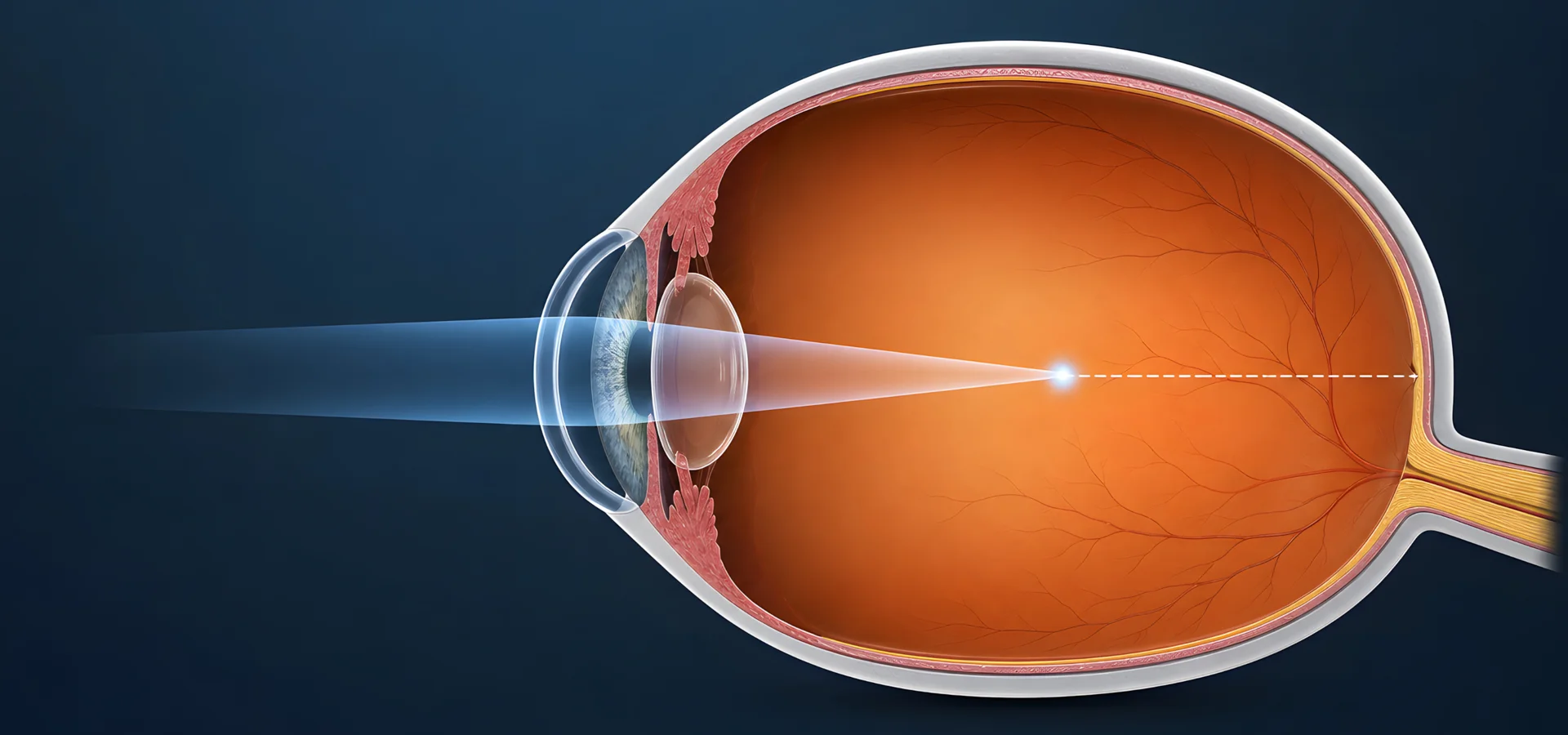
A longer, more myopic eye isn't just a stronger prescription. It's a structural change that carries real, measurable lifetime risk, which is exactly why we treat myopia as an eye health condition.
A myopic eye is longer, front to back, than an eye without myopia. That extra length has to come from somewhere, and it comes largely from the walls of the eye itself stretching, particularly the retina at the back and the tissue layers beneath it.
Stretched tissue is thinner and more fragile than tissue at its normal thickness. That's the structural reason a longer, more myopic eye carries higher lifetime risk of a specific group of conditions, quite separate from whether the blur itself is well corrected with glasses or contact lenses.
myopia-diseases-02.jpg — Diagram Of Retinal Stretching In A Long Eye
What The Risk Involves
Four Conditions Linked To Myopia
Each of these becomes more likely as axial length and prescription increase, though the mechanism differs for each.
Retinal Detachment
A stretched, thinner retina is more prone to developing tears, which can progress to detachment, a sight-threatening emergency. Risk rises significantly with increasing axial length.
Myopic Maculopathy
Progressive, degenerative changes to the macula, the central, detail-vision part of the retina, seen almost exclusively in high myopia. It's the leading cause of irreversible vision loss from myopia.
Glaucoma
Myopic eyes have a meaningfully higher risk of developing glaucoma, a condition where pressure-related damage to the optic nerve causes gradual, often symptomless vision loss.
Cataract
Myopia, particularly high myopia, is associated with earlier onset of certain cataract types, clouding of the eye's natural lens that gradually blurs and dims vision.
The Evidence
Risk Rises With Every Millimetre
Large population studies on axial length give us a genuinely useful way to picture cumulative lifetime risk.
What The Research Shows
Research examining lifetime risk of uncorrectable vision impairment by axial length found the risk roughly doubles once the eye exceeds about 26mm, and rises to somewhere between 11 and 25 times background risk once it exceeds 28mm. Beyond 30mm, cumulative lifetime risk of vision impairment has been estimated at around 90%.
Framed by prescription, high myopia (-6.00D or stronger) was associated with roughly a 39% cumulative incidence of vision impairment by age 75 in the same research, compared with a low single-digit percentage for mild myopia. The relationship isn't a single cut-off; it's a curve that climbs with every extra dioptre and every extra millimetre, which is precisely why we track both, and why slowing progression during childhood has such long-term value.
myopia-diseases-03.jpg — Dilated Retinal Examination In Progress
How We Monitor For These Conditions
Because most of these conditions develop gradually and often without early symptoms, regular comprehensive eye examinations are the main way we catch them early, when they're most manageable. For higher myopia in particular, that means periodic dilated retinal examination and, where appropriate, optical coherence tomography (OCT) imaging of the macula and optic nerve.
For children and progressing young adults, the most valuable long-term strategy is prevention rather than early detection alone: slowing axial elongation now, through myopia control treatment, so the eye simply doesn't reach the higher-risk range in the first place. Our Myopia Control page explains how.
myopia-related-eye-diseases-02.jpg — Myopia Eye Health Review Photo
Common Questions
Myopia-Related Eye Diseases: FAQs
Why does myopia increase the risk of other eye diseases?
As the eye elongates, its internal structures, particularly the retina, stretch and thin along with it. That stretching makes the retina more fragile and more prone to tearing or detaching, and it changes the drainage and structural properties of the eye in ways that raise the risk of glaucoma and cataract too. The longer the eye, the greater the structural strain.
At what prescription does risk become significant?
Risk rises gradually with every dioptre rather than jumping at one exact cut-off, but high myopia, generally -6.00D or stronger, is where the increase becomes most pronounced. Research on axial length shows the risk of uncorrectable vision impairment climbs steeply once the eye exceeds about 26mm, and climbs sharply again beyond 28-30mm.
Can these diseases be prevented?
The most effective prevention is slowing myopia progression while a child is still growing, since a shorter final axial length carries meaningfully lower lifetime risk. This is the core rationale behind myopia control treatment. Beyond that, regular comprehensive eye examinations allow early detection of these conditions, when they're most treatable.
Does correcting myopia with glasses or contact lenses reduce this risk?
No. Glasses, contact lenses and standard OrthoK correct blur by refocusing light, but they don't change the eye's physical length, so they don't reduce this structural risk. Only slowing the rate of axial elongation, through myopia control treatment during the growing years, has been shown to lower it.
How often should someone with myopia have their eyes checked?
This depends on age, prescription and whether myopia is still progressing. Progressing children are typically reviewed every six months. Adults with stable, low myopia are usually fine with standard annual reviews, while those with high myopia benefit from more thorough, periodic retinal assessment given their higher lifetime risk.
Is high myopia the same as pathological myopia?
Not quite. High myopia describes the prescription (generally -6.00D or stronger). Pathological or degenerative myopia describes a subset of high myopia where structural changes, such as myopic maculopathy, have actually developed. Most people with high myopia don't develop pathological changes, but the risk is meaningfully higher than in low myopia, which is why monitoring matters.
What are the warning signs of a retinal detachment?
Sudden flashes of light, a shower of new floaters, or a shadow or curtain creeping across part of your vision are all warning signs that need same-day attention. Retinal detachment is a genuine eye emergency, and acting quickly gives the best chance of preserving vision.
Can myopic maculopathy be treated?
Some complications of myopic maculopathy, such as abnormal blood vessel growth, can be treated with injections if caught early, but the underlying degenerative changes themselves generally can't be reversed. This is why prevention, through myopia control in childhood, and regular monitoring matter so much.
Does wearing glasses or contact lenses increase my risk of these diseases?
No. Glasses and contact lenses simply refocus light; they don't change the eye's physical length or add any risk themselves. The risk comes from the axial elongation itself, not from how the resulting blur is corrected.
Should someone with high myopia avoid contact sports?
Not necessarily, but it's worth discussing individually, particularly if there's any pre-existing retinal thinning or if a comprehensive retinal examination hasn't been done recently. We can advise on precautions and appropriate eyewear for sport based on your specific eye health.
Protect Vision For Life, Not Just For Now
A comprehensive eye health assessment, including axial length measurement and retinal imaging where appropriate, gives you a clear picture of long-term risk, not just today's prescription.