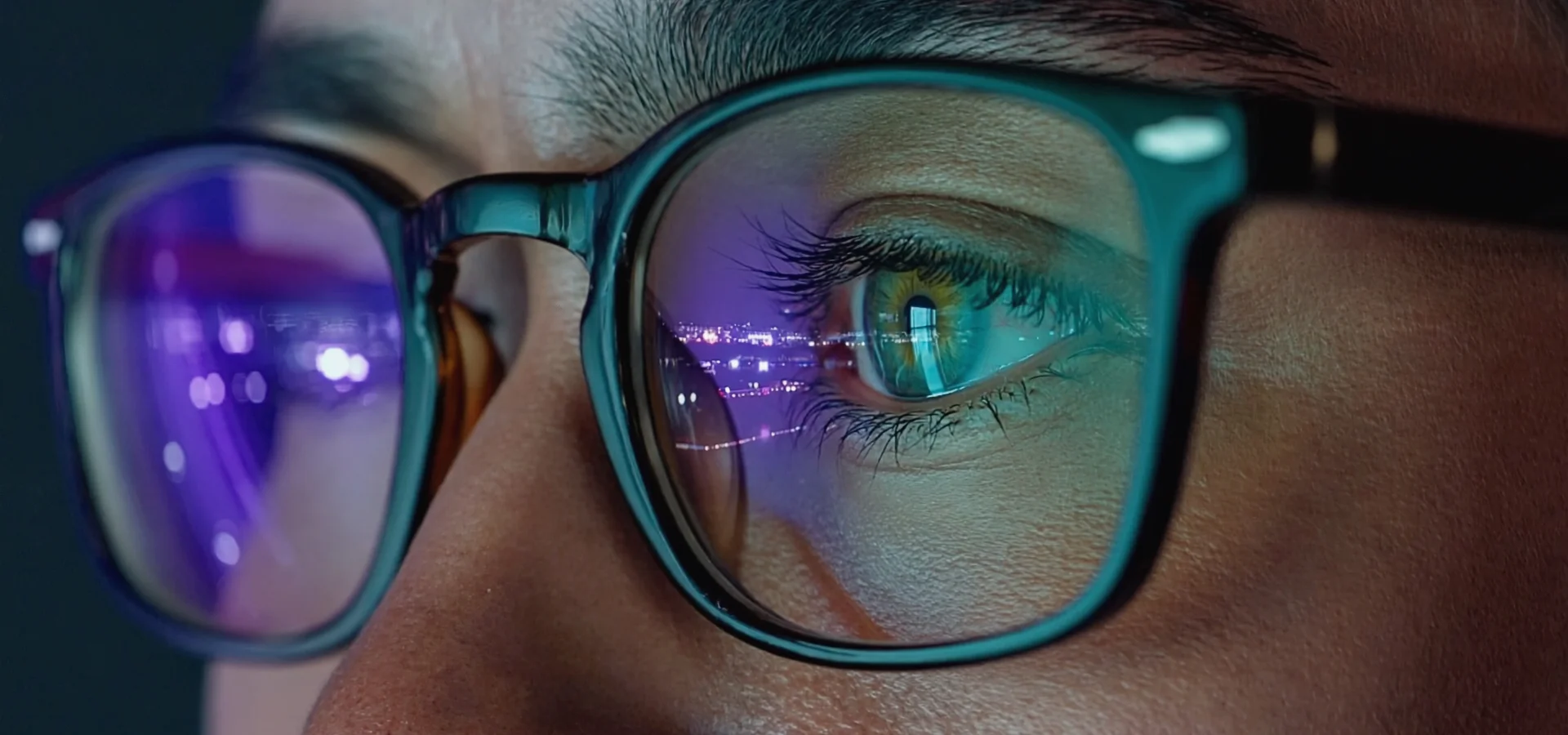
Blue light lenses are one of the most heavily marketed products in eyewear, and also one of the most misunderstood. Here's what blue light actually is, what current research does and doesn't support, and when we'd genuinely recommend one.
Visible light is made up of a spectrum of wavelengths, and blue light sits at the shorter, higher-energy end of that spectrum, roughly 400 to 500 nanometres. It's part of ordinary daylight, and it's what gives a clear sky its colour. It also plays a genuine biological role: blue light exposure during the day helps regulate your circadian rhythm, the internal clock that governs alertness and sleep.
Screens, phones, tablets and LED lighting all emit some blue light, but considerably less than the sun does. Sitting outdoors on an overcast day exposes your eyes to more blue light than several hours in front of a monitor.
FIG. 01 — VISIBLE LIGHT SPECTRUM, 400-500NM
What The Evidence Says
Separating Marketing From Research
We'd rather explain this properly than sell you a lens with promises it may not keep.
The Honest Summary
Blue-light filtering lenses do reduce the amount of blue light reaching your eyes, that part is measurable. What's far less certain is whether that filtering meaningfully reduces digital eye strain. Current systematic reviews of the available clinical trials have generally found the evidence low-certainty and inconsistent, meaning we can't confidently say blue-light lenses reduce eye strain more than an ordinary lens does.
That doesn't mean blue-light lenses are pointless, only that they shouldn't be sold as a proven fix for tired eyes. If you'd like the added filtering, we're glad to include it. We just won't tell you it will solve a problem the research hasn't confirmed it solves.
Reduced Blink Rate
Concentrating on a screen lowers how often you blink, drying the eye's surface. This is one of the better-supported causes of digital eye strain.
Uncorrected Prescription
Even a small, outdated prescription forces the eye to work harder to focus on screen text, and is a common, fixable cause of strain.
Glare & Reflections
Screen glare and lens-surface reflections make text harder to resolve. An anti-reflective coating has clearer evidence of improving comfort here.
Sustained Near Focus
Long, uninterrupted close-up focusing fatigues the eye's focusing muscles, regardless of the light involved.
FIG. 02 — EVENING LIGHT & CIRCADIAN TIMING
Where Blue Light Does Matter: Sleep Timing
The more established concern with blue light isn't eye damage, it's timing. Blue light exposure in the evening can suppress melatonin release and delay your body's signal that it's time to sleep. This is a real, well-studied effect, and it applies more to when you're exposed to screens than how bright or sharp your eyes feel the next day.
If evening screen use is disrupting your sleep, reducing screen brightness, using a warmer colour setting, or simply stepping away from devices an hour before bed tends to help more than a blue-light lens coating alone.
Our Options
Blue Light Filtering Across Our Lens Brands
If you'd like a blue-light filtering option, it's available across each of our partner lens brands, usually as a lens material or a coating layer.
HOYA
Lutina Lens Material
A clear lens material that filters violet and a portion of blue-violet light at the point of manufacture, rather than as a surface coating.
It depends what you mean by "work". They do filter a portion of blue light, that part is straightforward physics. Whether that filtering meaningfully reduces digital eye strain is less settled: current systematic reviews of the evidence have found low-certainty, inconsistent support for blue-light lenses reducing eye strain symptoms compared with standard lenses. Some patients still tell us they're more comfortable wearing them for long screen sessions, which may relate as much to glare reduction and correct prescription as to blue light itself.
What actually causes digital eye strain, if it's not blue light?
In most cases, it's a combination of reduced blink rate when concentrating on a screen, uncorrected or slightly out-of-date prescriptions, screen glare and reflections, and how close and how long you're focusing. Addressing these, an accurate prescription, a well set up workstation, and regular breaks, generally does more for comfort than a blue-light coating alone.
Should I still consider a blue light lens?
It's a reasonable option if you spend long hours on screens and want the added filtering, particularly combined with an anti-reflective coating, which does have clearer evidence for reducing glare and improving visual comfort. We're happy to include it if you'd like it, we just won't oversell it as a guaranteed fix for eye strain.
Does blue light from screens damage my eyes?
There's no strong evidence that the level of blue light emitted by phones, computers or tablets causes lasting retinal damage. For context, natural daylight contains far more blue light than any screen. The more established concern with screens and blue light relates to evening exposure and its effect on sleep timing, not eye health itself.
Can children use blue light lenses?
Yes, blue-light filtering coatings can be added to children's lenses, and some myopia control lenses include violet or blue-light filtering as a feature of the material itself. If screen use and myopia are both concerns, it's worth discussing myopia control options at the same time, since that addresses the more significant long-term risk.
How much does a blue light coating cost?
Blue light filtering is typically added as an optional lens coating or lens tint, priced as an add-on to your chosen lens rather than a separate product. We'll give you an exact cost alongside your lens quote once we know which base lens and coatings you're after.
What actually helps with digital eye strain if blue light isn't the main cause?
The bigger drivers are usually reduced blink rate during screen focus, uncorrected or slightly outdated prescriptions, poor screen ergonomics, and dry eye. We generally recommend the 20-20-20 rule, taking a 20 second break to look at something 20 feet away every 20 minutes, alongside an accurate, up-to-date prescription and, where relevant, dry eye management.
Do blue light glasses help me sleep better?
There's more research support for reducing evening screen exposure generally than for blue light lenses specifically improving sleep. If screen use before bed is disrupting your sleep, reducing screen time or using device night-mode settings in the hour before bed is likely to matter more than the lens coating itself.
Can I get blue light filtering without a prescription, just for computer use?
Yes, we can fit non-prescription blue light lenses for patients who don't otherwise need corrective glasses but want the coating for extended screen work. It's worth having your eyes checked first regardless, since undiagnosed prescription changes are a more common cause of screen-related discomfort than blue light exposure.
Where can I get blue light glasses fitted in Melbourne?
We fit blue light filtering lenses and coatings at our Kew East practice, as part of a comprehensive eye test that also checks for the more common, evidence-backed causes of digital eye strain. We see patients from across Melbourne's inner east and further afield for screen-related vision concerns.
Not Sure If You Need One?
Bring your screen habits and any symptoms you've noticed to your next eye test, and we'll help you work out whether a blue-light option, an updated prescription, or a change in habits will help most.