A cataract clouds the eye's natural lens, gradually softening and dulling the way you see the world. Here's what causes it, how we detect it early, and what treatment actually involves.
Many people describe the early stage of a cataract as looking through a fogged-up window. Colours seem a little duller, reading feels more effortful in dim light, and night driving becomes harder because oncoming headlights scatter into a glare. This isn't a new problem with the eye's focusing power. It's a change to the lens itself.
A cataract develops when the proteins inside the eye's natural lens, normally arranged in a precise, transparent structure, begin to clump together. As these clumps grow, they cloud a lens that once let light pass through cleanly. Light entering the eye scatters instead of focusing sharply on the retina, and vision softens as a result.
Cataracts almost always progress gradually, often over several years, which is exactly why so many people don't notice the change until it starts interfering with daily life. They're one of the most common eye health conditions affecting Australians as they age, though younger people can develop them too, from causes such as diabetes, long-term UV exposure, certain medications or a previous eye injury.
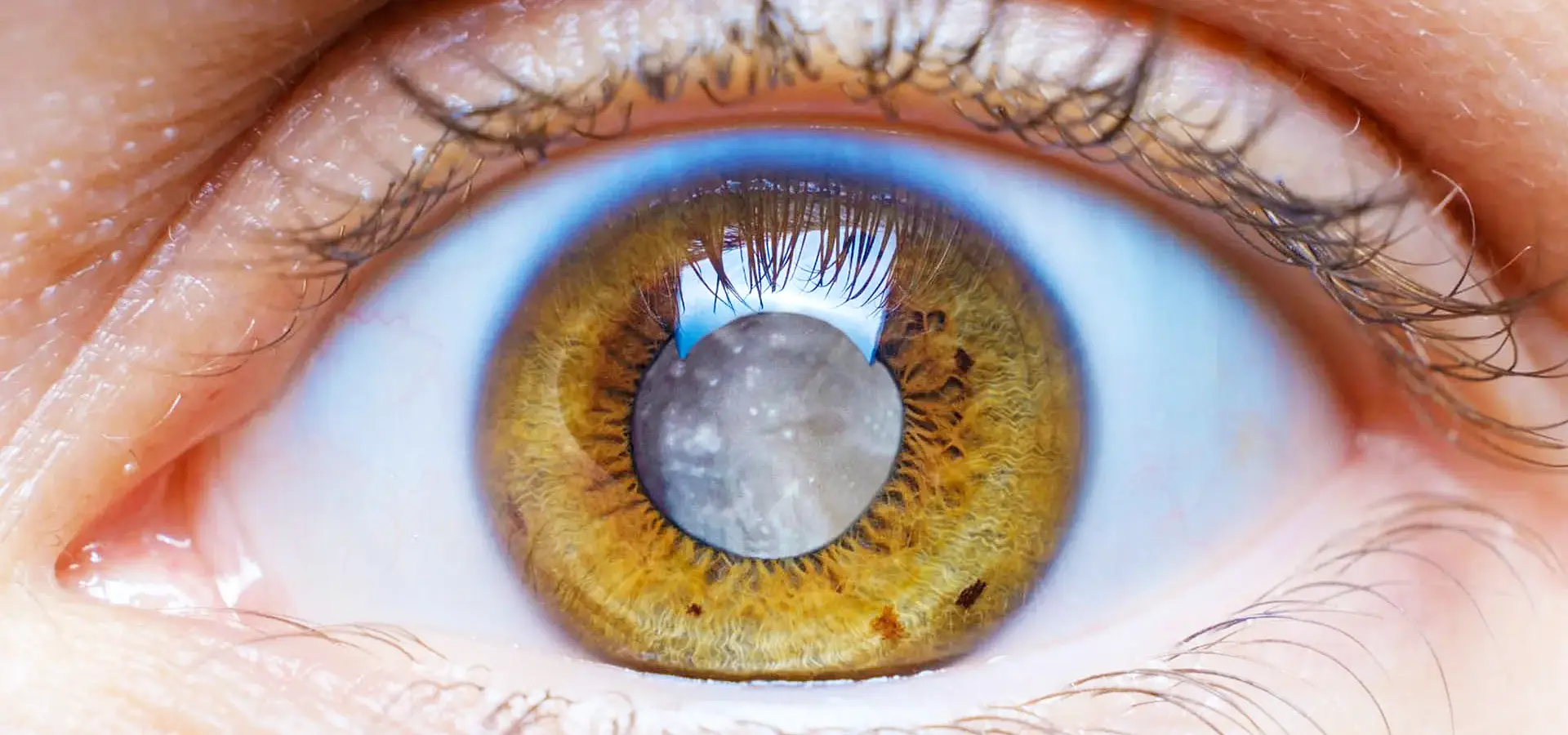
Because cataracts develop slowly, the symptoms are often subtle at first and only become obvious in hindsight. These are the changes we hear about most often from patients.
Objects lose their crispness, as though viewed through a light mist that doesn't clear with a blink.
Headlights, streetlights and even lamps can appear surrounded by a ring of light, especially at night.
Colours that were once vivid can take on a subtle yellow or brown tint and appear less rich.
Your glasses seem to need updating more often than usual, without a clear reason why.
Reduced contrast and increased glare make judging distances and reading signs harder after dark.
Some people notice a ghosted or doubled image in a single eye, separate from general blurring.
A cataract is an eye health condition, not simply an inconvenience to work around. Left unmanaged, it continues to cloud the lens, though the pace varies considerably from person to person and even between someone's two eyes.
The impact reaches further than reading a menu or seeing a screen clearly. Reduced contrast and glare sensitivity affect driving safety, and in older adults, declining vision is a recognised contributor to falls and loss of independence. Cataracts can also make it harder to get a clear view of the retina during an eye examination, which matters because they can coexist with other conditions, such as glaucoma or macular degeneration, that need their own separate monitoring.
This is why a comprehensive assessment matters more than a quick check. Understanding exactly how a cataract is affecting your vision, and what else might be happening at the back of the eye, is what allows the right treatment decision to be made at the right time for you.
The eye's lens sits just behind the iris and is made largely of water and structural proteins, arranged in a precise pattern that keeps it transparent. As we age, oxidative stress and years of cumulative UV exposure gradually alter these proteins, causing some of them to unfold and clump together. Where those clumps form, light no longer passes through cleanly, and that area of the lens becomes cloudy.
Cataracts are classified by where the clouding occurs. A nuclear cataract forms in the central core of the lens and tends to develop slowly, often causing a temporary improvement in near vision before distance vision declines. A cortical cataract develops in wedge-shaped streaks around the outer edge of the lens and is a common cause of glare. A posterior subcapsular cataract forms at the back of the lens and, although often smaller, can have an outsized effect on reading vision and glare because of its position directly in the path of light.
Understanding which type, or combination of types, is present helps explain the specific symptoms someone is experiencing and gives a clearer picture of how the cataract is likely to progress.
Cataracts are identified during a comprehensive eye examination, well before most people would notice symptoms significant enough to seek help on their own.
Measures how clearly you're seeing at distance and near, establishing a baseline and tracking change over time.
A magnified, illuminated view of the lens that lets us directly see the location and density of any clouding.
Widening the pupil gives a full view of the lens periphery and the retina behind it for a complete picture.
Confirms whether other conditions are present alongside the cataract, so nothing is missed or misattributed.
Glasses can't remove a cataract. What they can do, in the early stages, is compensate for the change in the lens while that change is still mild. Surgery is the only way to clear the clouding itself, which is why cataract care is really a question of timing rather than a single fixed step. Here's how that decision typically unfolds.
Once a cataract is identified, we establish how advanced it is and set a monitoring schedule to track how it changes over time.
While a cataract is mild, an updated glasses prescription can sharpen vision by correcting the refractive shift it causes. This eases symptoms temporarily, it doesn't treat the underlying clouding.
We talk through how the cataract is actually affecting your daily life, driving, reading, work, hobbies, so the decision to proceed reflects your circumstances rather than the diagnosis alone.
When vision is meaningfully affecting your life, we refer you to a trusted ophthalmologist for a surgical consultation, with our findings to support their assessment.
An outpatient procedure in which the cloudy lens is removed and replaced with a clear artificial intraocular lens. It's one of the most commonly performed and consistently successful procedures in modern medicine.
After healing, we reassess your vision and update your spectacle prescription if needed, continuing your eye care alongside your surgeon.
Cataract care doesn't end at diagnosis. As one of Melbourne's most experienced myopia and eye health clinics, our focus at Eyecare Concepts is on personalised, evidence-based monitoring that respects how differently cataracts can progress from one person to the next, rather than applying a single timeline to everyone.
Advanced imaging technology gives us a detailed, repeatable record of the lens and retina, so we can track subtle change with confidence rather than guesswork. When the time comes for a surgical opinion, we work alongside trusted Melbourne ophthalmologists and remain involved before and after the procedure, so your care stays coordinated rather than handed off.
Above all, we aim to give you the information you need to make this decision on your own timeline, with a clear understanding of what's happening and why. Our Kew East practice is easily accessible from across Melbourne's inner east, including Hawthorn, Camberwell, Balwyn and Box Hill.
If your vision has changed, or it's simply been a while since your last check, a comprehensive assessment gives us a clear picture of your eye health and the most appropriate management plan for you.